
The Vlasto Family In Rome, From c. 100 A.D.
1997
Vlastos in Rome
See other pages concerning the history of the Vlasto family

Rome – 100-120 AD – The Funerary Altar Dedicated To Claudius Vlasto at the Vatican Museum
This ancient monument reads:
D . M .
CLODIO BLASTO
CLODIUS BLASTUS
FIL. PATRI DVLCISSIM[O]
B.M.F.
ET CLODIA CHARIS
CONIVGI B.M.F.
This funerary altar, dating from 100-120 AD, was made in honour of Claudius Vlasto on the initiative of his son and namesake, Claudius Vlasto. It also commemorates his wife, Claudia Charis, as a later addition to the inscription. Although the wording is in Latin and the names have been latinised, the name 'Charis' is Greek and means 'Grace', indicating that the Greek origin is proudly acknowledged. Costas Kerofilas says that the use of the letter B in place of V for 'Vlasto' establishes an early date for the monument and that it belongs to a branch of the 'great Greek family which was established early in Rome'.
In the first chapter of Les Vlasto - Une famille patricienne crétoise, (1936) Costas Kérofilas mentions this monument in the Vatican Museum collection. The Vatican describes its origins as:
"Altare Funerario di Clodius Blastus
Forse venne venduto ai Musei nel 1783 dalla Contessa Livia Buzj Moroni (che aveva molte opere provenienti dalla Vigna Moroni sull'Appia, presso il Sepolcro degli Scipioni). La dedica viene fatta agli Dei Mani ed al padre – Clodio Blastus – dall'ononimo figlio. Con lettere leggermente piu piccole (et in uno spazio di risulta in basso) la moglie Clodia Charis, benemerente (e forse risentita della iniziale dimenticanza!), si fa aggiungere come dedicante. Al di sopra e un coronamento con due volute, ornate di fiori, tra palmette acroteriali; sulle facce laterali sono l'urceus et la patera. E databile al 100-120 d.C."
Translated:
"Funerary Monument to Clodius Blastus
Perhaps sold to the Museums of the Vatican in 1783 by Countess Livia Buzj Moroni (who had numerous works of art from the Vigne Moroni near the Scipion tomb). The Vigne Moroni, being a very important excavation site, produced numerous artefacts of which the Vatican Museum has beautiful examples. The monument's dedication is: "Into the hands of God, Claudius Vlasto, most excellent, from his son Claudius Vlasto."
The Vatican's catalogue entry then suggests that the mention of his wife, Claudia Charis, in slightly smaller lettering in a space below, may have been added as an after-thought. This seems unlikely. Almost certainly the space was left blank (as is quite common) so that her name could be added when she died later and the letters B.M.F. in both cases refer to the son ('filius') being the benefactor of the monument to his parents.
The Vatican's description also refers to a 'crowning' feature to the monument consisting of two ornamental floral volutes and crossed palms. The side panels of the monument display an 'urceus' and 'patera' – a vase and a chalice (or cup).
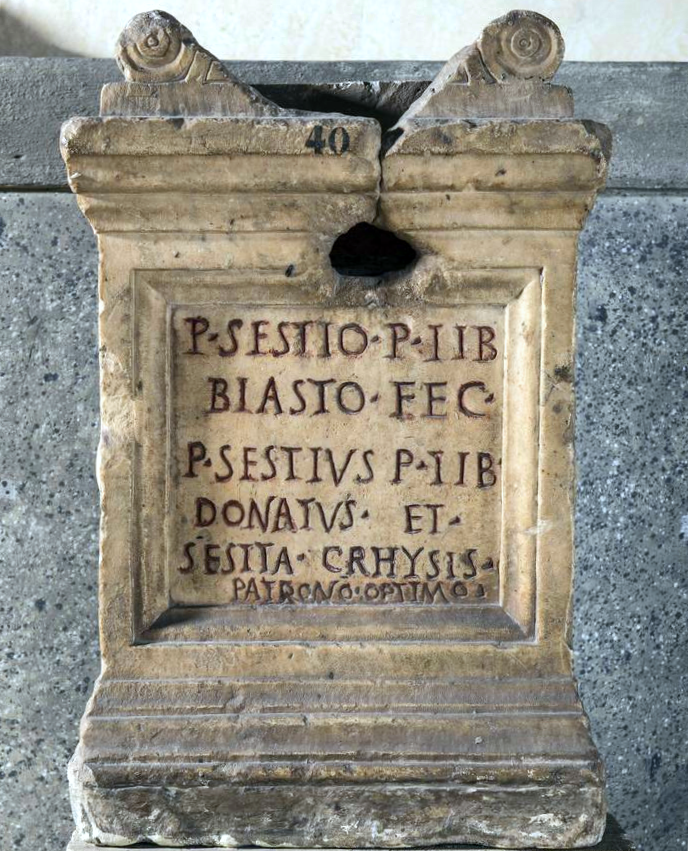
A second funerary altar naming Publius Sestius Blasto (Vlasto), found in Ostia and formerly part of the bishop's seat, now in the Vatican Museum collection.
Rome – c.185 AD
Vlasto tries and fails to fix the date of Easter
with consequences to this day.
The Greek priest and theologian Vlasto became prominent in Rome during the reign of Commodus (180 – 192 A.D.) – the son of Marcus Aurelius who had persecuted the Christians in Rome. Vlasto was a contemporary of St Irenaeus to whom he dedicated an epistle. At a time of great schisms in the early Christian church in Rome, Vlasto caused added controversy. Unjustifiably he was accused of promoting Judaism when he was said to have proposed that the date of Easter should be 'fixed' and celebrated on the 14th day of the month. This would, incidentally, have accorded with the laws of Moses – hence the accusation that he, though Greek, was promoting Judaistic beliefs. However, Greeks from the Levant did indeed present Rome with problems when they insisted on celebrating Easter Day according to their own local customs.
[See:
- The Appendix of De Praescriptione by St Tertullian, who, like Vlasto, was a member of the Montanist Sect from Phrygia]. In fact, as a Gnostic, Vlasto would have been entirely opposed to Old Testament Judaism.
- Decline and Fall of The Roman Empire (Ch. XV) by Edward Gibbons]
It's clear from the later writings of Theodoret (c.393 – 458 A.D.) and of Eusebius (264 – 340 A.D., Bishop of Caesarea, father of Church history and biographer of Constantine The Great) that Vlasto and Florinus were eminent figures in Rome who nevertheless caused immense controversy in the earliest days of Christianity by attempting and failing to establish a fixed date for the celebration of Easter. Their reasons for proposing this were undoubtedly practical since, even today, the calculation of Easter involves an extraordinarily complicated mathematical process and, paradoxically, has its origin in pre-biblical pagan fertility rites associated with phases of the moon. Even St Irenaeus, Vlasto's contemporary and friend, condemned his view in letters to him.
Many attempts have since been made to fix the date of Easter since its irrational timing makes other Church feasts equally difficult to calculate – unlike Christmas.
[See:
- Ecclesiastical History (Ch. V.15 and V.20) by Eusebius
- History of Heresies (Ch. 1.23) by Theodoret
- First Epistle by Theodoret]
Rome – 185 AD – Vlasto out-voted at the First Church Council
At approximately the same time a prominent Christian leader in Rome was another Vlasto who headed the Marcionite Sect of Gnostics and whose views as a Gnostic were also criticised. He was out-voted at the first Church Council in Rome where Gnosticism was declared heretical.
[See:
- The Dictionary of Christian Biography by Smith & Wace
- History of Heresies (Ch. 1.25) by Theodoret]
See other pages concerning the history of the Vlasto family
St Irenaeus & Pope Victor l
Vlasto (Blastus) & The Easter Debate
An explanation of the life and works of St Irenaeus, father of the Christian church and his relationship with other early fathers of the Christian church in Rome such as Vlasto (Blastus)
An explanation of the life and works of Pope Victor l and his relationship with early fathers of the Christian church in Rome such as St Irenaeus, Vlasto and the great Easter Debate.
For these I am grateful to Albert Poncelet and J. P. Kirsch, writers for the Catholic Encyclopedia.
See also: The Vlasto Family in Rome 1-2 AD
St. Irenaeus Bishop of Lyons, and Father of the Church. Information as to his life is scarce, and in some measure inexact. He was born in Proconsular Asia, or at least in some province bordering thereon, in the first half of the second century; the exact date is controverted, between the years 115 and 125, according to some, or, according to others, between 130 and 142.
It is certain that, while still very young, Irenaeus had seen and heard the holy Bishop Polycarp (d. 155) at Smyrna. During the persecution of Marcus Aurelius, Irenaeus was a priest of the Church of Lyons. The clergy of that city, many of whom were suffering imprisonment for the Faith, sent him (177 or 178) to Rome with a letter to Pope Eleutherius concerning Montanism, and on that occasion bore emphatic testimony to his merits.
Returning to Gaul, Irenaeus succeeded the martyr Saint Pothinus as Bishop of Lyons. During the religious peace which followed the persecution of Marcus Aurelius, the new bishop divided his activities between the duties of a pastor and of a missionary (as to which we have but brief data, late and not very certain) and his writings, almost all of which were directed against Gnosticism, the heresy then spreading in Gaul and elsewhere.
In 190 or 191 he interceded with Pope Victor to lift the sentence of excommunication laid by that pontiff upon the Christian communities of Asia Minor which persevered in the practice of the Quartodecimans in regard to the celebration of Easter. Nothing is known of the date of his death, which must have occurred at the end of the second or the beginning of the third century. In spite of some isolated and later testimony to that effect, it is not very probable that he ended his career with martyrdom. His feast is celebrated on 28 June in the Latin Church, and on 23 August in the Greek.
Irenaeus wrote, in Greek, many works which have secured for him an exceptional place in Christian literature, because in controverted religious questions of capital importance they exhibit the testimony of a contemporary of the heroic age of the Church, of one who had heard St. Polycarp, the disciple of St. John, and who, in a manner, belonged to the Apostolic Age. None of these writings have come down to us in the original text, though a great many fragments of them are extant as citations in later writers (Hippolytus, Eusebius, etc.). Two of these works, however, have reached us in their entirety in a Latin version:
- A treatise in five books, commonly entitled Adversus Haereses, and devoted, according to its true title, to the Detection and Overthrow of the False Knowledge (Gnosticism). Of this work we possess a very ancient Latin translation, the scrupulous fidelity of which is beyond doubt. It is the chief work of Irenaeus and truly of the highest importance; it contains a profound exposition not only of Gnosticism under its different forms, but also of the principal heresies which had sprung up in the various Christian communities, and thus constitutes an invaluable source of information on the most ancient ecclesiastical literature from its beginnings to the end of the second century. In refuting the heterodox systems Irenaeus often opposes to them the true doctrine of the Church, and in this way furnishes positive and very early evidence of high importance. Suffice it to mention the passages, so often and so fully commented upon by theologians and polemical writers, concerning the origin of the Gospel according to St. John, the Holy Eucharist and the primacy of the Roman Church.
- Of a second work, written after the Adversus Haereses, an ancient literal translation in the Armenian language. This is the Proof of the Apostolic Preaching. The author's aim here is not to confute heretics but to confirm the faithful by expounding the Christian doctrine to them and notably by demonstrating the truth of the Gospel by means of the Old Testament prophecies. Although it contains fundamentally, so to speak, nothing that has not already been expounded in the Adversus Haereses, it is a document of the highest interest, and a magnificent testimony of the deep and lively faith of Irenaeus.
Of his other works only scattered fragments exist; many, indeed, are known only through the mention made of them by later writers, not even fragments of the works themselves having come down to us. These are:
- a treatise against the Greeks entitled On the Subject of Knowledge (mentioned by Eusebius)
- a writing addressed to the Roman priest Florinus On the Monarchy, or How God is not the Cause of Evil (fragment in Eusebius)
- a work On the Ogdoad, probably against the Ogdoad of Valentinus the Gnostic, written for the same priest Florinus, who had gone over to the sect of the Valentinians (fragment in Eusebius)
- a treatise on schism, addressed to Vlasto [Blastus] (mentioned by Eusebius)
- a letter to Pope Victor against the Roman priest Florinus (fragment preserved in Syriac)
- another letter to the same on the Paschal controversies (extracts in Eusebius)
- other letters to various correspondents on the same subject (mentioned by Eusebius, a fragment preserved in Syriac)
- a book of divers discourses, probably a collection of homilies (mentioned by Eusebius)
- other minor works for which we have less clear or less certain attestations
The four fragments which Pfaff published in 1715, ostensibly from a Turin manuscript, have been proven by Funk to be apocryphal, and Harnack has established the fact that Pfaff himself fabricated them.
The Easter Debate and Vlasto
Pope St. Victor I (189-198 or 199), date of birth unknown. The Liber Pontificalis makes him a native of Africa and gives his father the name of Felix. This authority, taking the Liberian Catalogue as its basis, gives the years 186-197 as the period of Victor's episcopate. The Armenian text of the Chronicle of Eusebius (Leipzig, 1911, p. 223) places the beginning of Victor's pontificate in the seventh year of the reign of the Emperor Commodus (180-87) and gives it a duration of twelve years; in his Church History (V, xxxii, ed. Schwarts, Leipzig, 1902, p. 486) Eusebius transfers the beginning of the pontificate to the tenth year of the reign of Commodus and makes it last ten years.
During the closing years of the reign of Commodus (180-192) and the early years of Septimius Severus (from 193) the Roman Church enjoyed, in general, great external peace. The favourable opinion of the Christians held by Commodus is ascribed to the influence of a woman named Marcia. According to the testimony of Hippolytus (Philosophumena, IX, 12) she had been brought up by the presbyter Hyacinthus, was very favourably inclined towards the Christians, perhaps even a Christian herself (Hippolytus, loc. cit., calls her philotheos, God-loving). One day she summoned Pope Victor to the imperial palace and asked for a list of the Roman Christians who had been condemned to forced labour in the mines of Sardinia, so that she might obtain their freedom. The pope handed her the list and Marcia, having received from the emperor the required pardon, sent the presbyter Hyacinthus to Sardinia with an order of release for the Christian confessors. Callistus, afterwards pope, who had been among those deported, did not return to Rome, but remained at Antium, where he received a monthly pension from the Roman Christians.
Irenaeus (Adv. Haerses, IV, xxx, 1) points out that Christians were employed at this period as officials of the imperial Court. Among these officials was the imperial freedman Prosenes, whose gravestone and epitaph have been preserved (De Rossi, Inscriptiones Christ. Urbis Romae, I, 9, no. 5). Septimius Severus, also, during the early years of his reign, regarded the Christians kindly, so that the influence of Christian officials continued. The emperor retained in his palace a Christian named Proculus who had once cured him. He protected Christian men and women of rank against the excesses of the heathen rabble, and his son Caracalla had a Christian wet nurse (Tertullian, Ad Scapulam, IV). Christianity made great advances in the capital and also found adherents among the families who were distinguished for wealth and noble descent (Eusebius, Hist. Eccl., V, xxi).
Internal dissensions during this era affected the Church at Rome. The dispute over the celebration of Easter grew more acute. The Christians at Rome, who had come from the province of Asia, were accustomed to observe Easter on the 14th day of Nisan, whatever day of the week that date might happen to fall on, just as they had done at home.
This difference inevitably led to trouble when it appeared in the Christian community of Rome. Pope Victor decided, therefore, to bring about unity in the observance of the Easter festival and to persuade the Quartodecimans to join in the general practice of the Church. He wrote to Bishop Polycrates of Ephesus and induced the latter to call together the bishops of the province of Asia in order to discuss the matter with them. This was done; but in the letter sent by Polycrates to Pope Victor he declared that he firmly held to the Quartoceciman custom observed by so many celebrated and holy bishops of that region. Victor called a meeting of Italian bishops at Rome, which is the earliest Roman synod known. He also wrote to the leading bishops of the various districts, urging them to call together the bishops of their sections of the country and to take counsel with them on the question of the Easter festival.
Letters came from all sides: from the synod in Palestine, at which Theophilus of Caesarea and Narcissus of Jerusalem presided; from the synod of Pontus over which Palmas as the oldest presided; from the communities in Gaul whose bishop was Irenaeus of Lyons; from the bishops of the Kingdom of Osrhoene; also from individual bishops, such as Bakchylus of Corinth. These letters all unanimously reported that Easter was observed on Sunday. Victor, who acted throughout the entire matter as the head of Catholic Christendom, now called upon the bishops of the province of Asia to abandon their custom and to accept the universally prevailing practice of always celebrating Easter on Sunday. In case they would not do this he declared they would be excluded from the fellowship of the Church.
This severe procedure did not please all the bishops. Irenaeus of Lyons and others wrote to Pope Victor; they blamed his severity, urged him to maintain peace and unity with the bishops of Asia, and to entertain affectionate feelings toward them. Irenaeus reminded him that his predecessors had indeed always maintained the Sunday observance of Easter, as was right, but had not broken off friendly relations and communion with bishops because they followed another custom (Eusebius, Hist. Eccl., V, xxiii-xxv.).
We have no information concerning the further course of the matter under Victor I so far as it regards the bishops of Asia. All that is known is that in the course of the third century the Roman practice in the observance of Easter became gradually universal. In Rome itself, where Pope Victor naturally enforced the observance of Easter on Sunday by all Christians in the capital, an Oriental named Vlasto (Blastus), with a few followers, opposed the pope and brought about a schism, which, however, did not grow in importance (Eusebius, loc. cit., B, xx).
Pope Victor also had difficulties with a Roman priest named Florinus, who probably came from Asia Minor. As an official of the imperial court, Florinus had become acquainted in Asia Minor with St. Polycarp, and later was a presbyter of the Roman Church. He fell into the Gnostic heresy and defended the false learning of Valentine. St. Irenaeus wrote two treatises against him: On the Monarchy [of God] and that God is not the Author of Evil, and On the Ogdoad. Irenaeus also called Victor's attention to the dangerous writings of Florinus, who was probably degraded from his priestly functions by the pope and expelled from the Church (Eusebius, Hist. Eccl., V, xv, 20).
During the pontificate of Victor a rich Christian, Theodotus the Leather-seller, came from Constantinople to Rome and taught false doctrines concerning Christ whom he declared to be merely a man endowed by the Holy Ghost, at baptism, with supernatural power. The pope condemned this heresy and excluded Theodotus from the Church. The latter, however, would not submit, but, together with his adherents, formed a schismatic party, which maintained itself for a time at Rome. Victor may also have come into contact with the Montanists. Tertullian reports (Ad Praceam, 1) that a Roman bishop, whose name he does not give, had declared his acceptance of the prophecies of Montanus, but had been persuaded by Praxeas to withdraw. Duchesne (Histoire Ancienne de l'Eglise, I, 278) and others think Tertullian means Pope Eleutherius, but many investigators consider it more probable that he meant Pope Victor, because the latter had had much to do with the inhabitants of Asia Minor, and because, between 190 and 200, Praceas had gone from Rome to Carthage, where he was opposed by Tertullian. The question cannot be decided positively.
Jerome calls Pope Victor the first Latin writer in the Church (Chronicon, ad an. Abr. 2209); he mentions small treatises (Mediocria de Religione Volumina, loc. cit.; cf. De Viris Illustribus, XXXIV: "Victor, thirteenth bishop of the Roman city, the writer of certain opuscula on the paschal question and others, ruled the Church ten years under Severus"). Besides the letters touching the Easter controversy none of St. Victor's works is known. Harnack tried to prove that he was the author of the treatise against the dice-throwers (De Alcatoribus), erroneously ascribed to St. Cyprian (see Texte und Untersuchungen V, Leipzig, 1899), though the opinion is now universally rejected (cf. Harnack, Geschichte der Altchristl. Literatur, II, pt. II, 370).
It was during Victor's administration perhaps that the canon of Scripture used at Rome, and which has been partially preserved in the Muratorian Fragment, was drawn up. In the note concerning him in the Liber Pontificalis (ed. Duchesne, I, 137) the Easter controversy is also mentioned; in addition, the introduction of sequentes among the clergy is also attributed to him. It is not certain what this means, whether it applies to the acolytes or to the assistants who appeared later at Rome for such clergy were much occupied with the administration of their cures. In any case the note is one of those which the author arbitrarily inserted into the biographies of the various popes, and has, accordingly, no historical value. The same is true of the ordinance respecting the administration of baptism in cases of necessity ascribed to Pope Victor by the same author.
Eusebius, Hist. eccl., V, xx-xxvii; Liber Pontificalis, ed. Duchesne, I, 137-138; Acta SS., July, VI, 534-542; Langen, Geschichte der römishen Kirche, I (Bonn, 1881), 176 sqq., 179 sq., 182 sqq.; Duchesne, Histoire ancienne de l'église, I (Paris, 1906), 251 sq., 277 sq., 289 sqq.
St Irenaeus & Vlasto written by Albert Poncelet
Transcribed by Sean Hyland, dedicated to John O'Brien and Jackie Sheehan.
Pope Victor l, Vlasto & The Easter Debate written by J. P. Kirsch
Transcribed by Michael T. Barrett, dedicated to Victor Tiscornia
From the Catholic Encyclopedia, © 1913 by the Encyclopedia Press Inc.
The electronic version, © 1996 by New Advent, Inc.