
"Chicago – But With Big, Big Guns"
Globus (Zagreb) 31-07-1992
Christopher Long was one of the first of the few journalists to get into Sarajevo after the UN and Red Cross observers were forced to withdrew in the face of the recent merciless bombardment of the Bosnian capital. He says that the profiteering of the mafia may be playing as large a part in the continuation of the war as any military or political considerations...
By Christopher Long
L
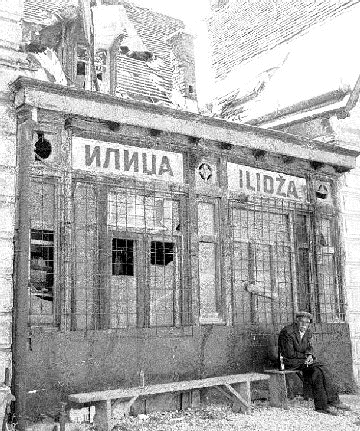
ast week I lay on my back under a beautiful, black, starry sky in the car-park of the PTT building in Central Sarajevo. A thousand metres to the west, parachute flares drifted through the sky, giving the machine-guns around Ilidza another minute to rattle death at each other.
To the south-west of me mortars were falling with sharp, vicious explosions every few minutes into the already shattered enclaves of Dobrinje and Ilidza around the airport.
A couple of kilometres away to the east, in the old Muslim quarter, the mortars made softer, duller detonations.
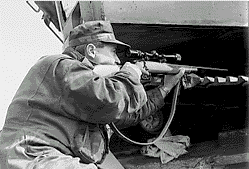
In a ruined apartment block, 200 metres south of my feet, a single anonymous sniper was shooting anonymous 9mm bullets at an anonymous target in another anonymous ruined apartment block somewhere near the old, burnt-out JNA barracks, 200 metres behind my head. Further away, dozens of other snipers were busy.
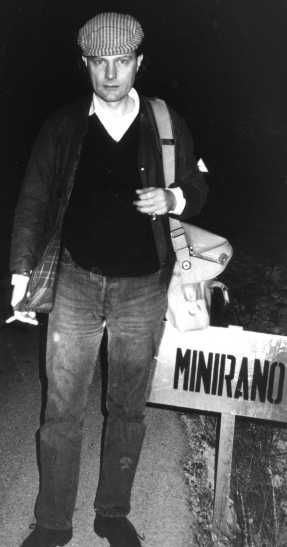
The author on a mined road on the Croatian border with Hercegovina in 1991.
As I had already done in Dubrovnik, Karlovac, Zadar, Sibernik, Knin, Mostar and Slavonia, I tried to remember my army training:
"Sound travels at 380 mph – four pulse beats equals 1,000 yards. Sound overtakes bullets at 2,000 yards – a double detonation is a rifle pointing in your direction. A rifle pointing in your direction with only a single detonation is 2,000 yards away."
So, people are dying before the sound of their deaths can reach me.
Artillery, mortar and small arms fire recorded in Sarajevo on the night of 26th July 1992.
 As I wondered whether I dared light a cigarette in the darkness, I reminded myself that the stars above this insane, ravaged city really are the same stars that shine down on London, Paris or New York.
Above me nervous French UNPROFOR troops whispered in the darkness, discussing their girl-friends in Lyons and the nightmare of making two more suicidal convoy trips to the airport in the morning – one of which was to take out a severely injured child who was hit, with other children, by a mortar in the gardens of the PTT buildings.
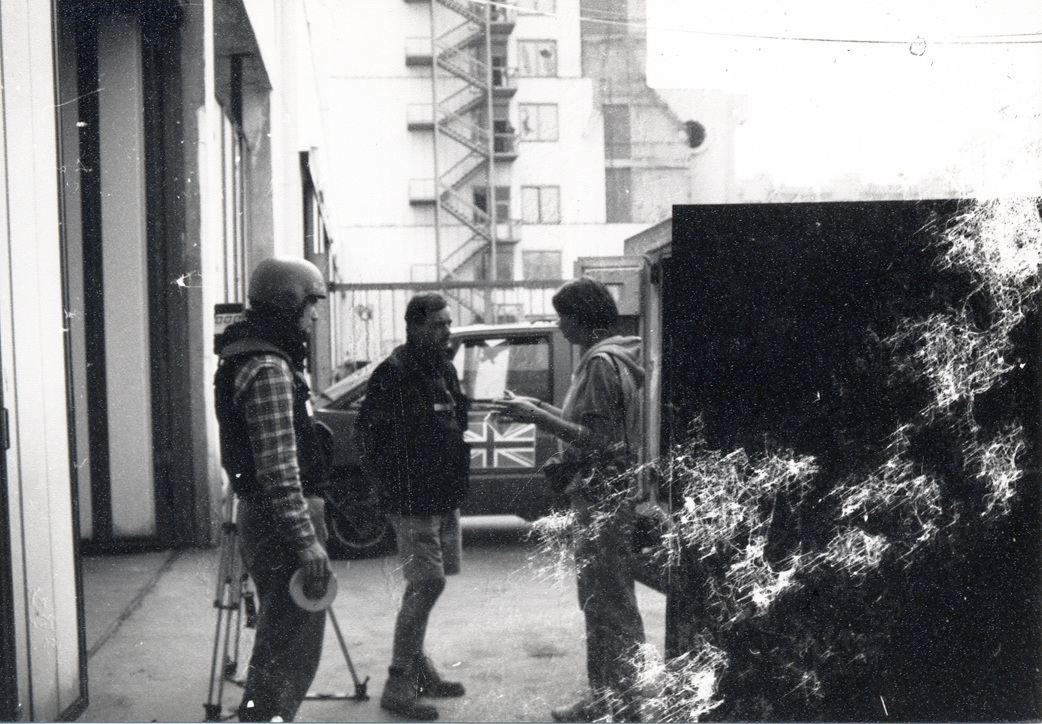
Recently arrived French troops used to gather on the fire escape steps visible in the background of this picture above to watch the tracer fire and night bombardments. Children like the one referred to in this article had learned to gather at the foot of the fire escape to catch sweets being thrown by well-intentioned UN troops. Inevitably they were targeted by a Serb sniper. Adults facing amputation were usually dosed with alcohol because anaesthetics were seldom available. Children, of course, had their limbs removed without any anaesthetic whatever.
 She and the other children had been taken to the main Kosova hospital in the north of the city where every window is smashed, there are huge holes in the walls and desperate doctors work day and night in appalling circumstances in the basements.
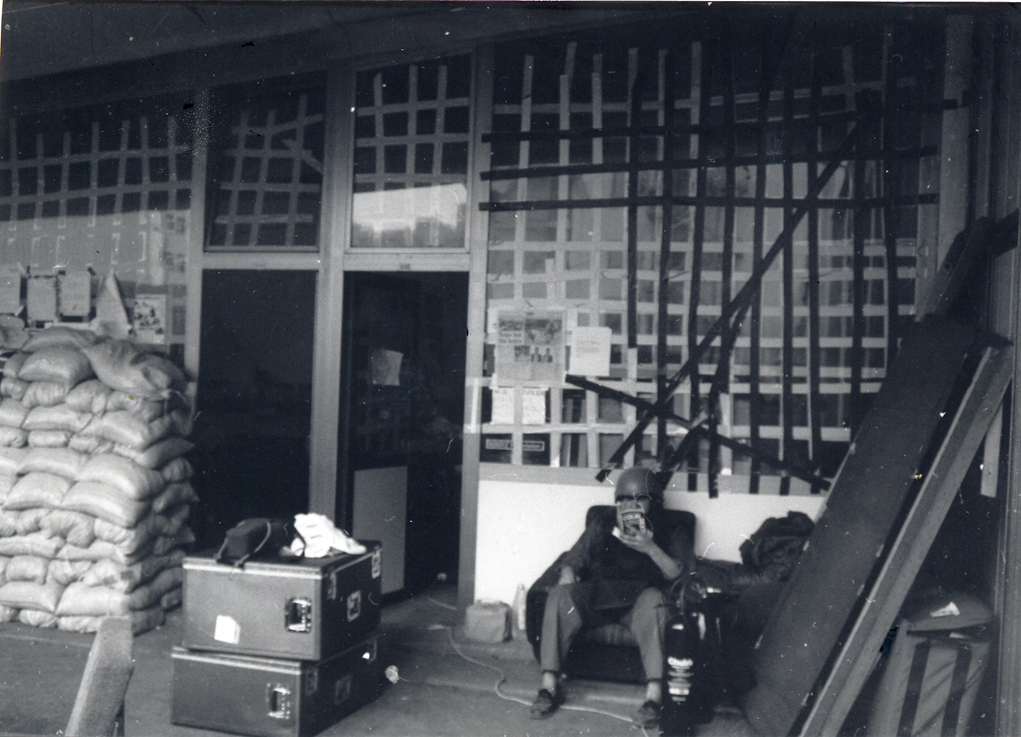
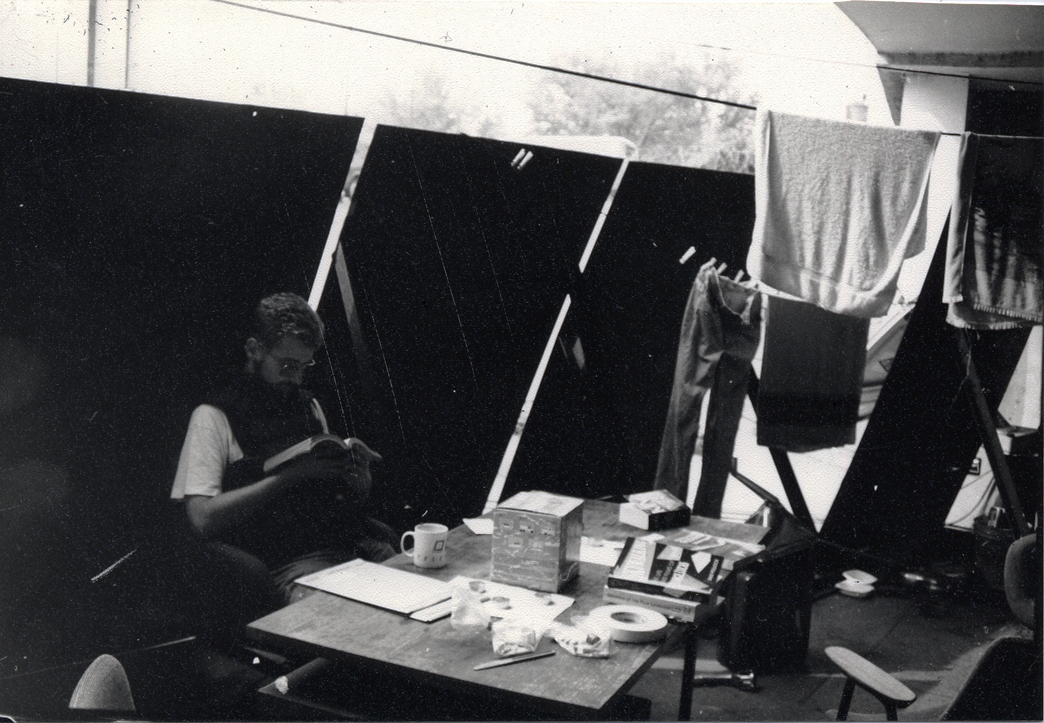
Right and above: The BBC bunker in Sarajevo was at the entrance to an underground car park beneath the PTT building (former Yugoslav state communications HQ). The last of these three poor quality pictures shows the steel plates which offered news crews a degree of protection against small calibre snipers' bullets only. The author spent three days here in July 1992, having driven into the besieged city via Ilizda from Kiseljak.
 I had arrived in this hellish city by car two days earlier from Kiseljak, 20 kms north-west of Sarajevo. I had driven from Split to Posusje and then along narrow, winding mountain tracks to Jablanica before taking even worse mountain trails (known to the British army as Diamond Route) to Kiseljak – following the route taken by the relief convoys of Medecins Sans Frontieres, Medecins Du Monde, Solidarite and Mehammet.
[A month or two later, this northern route into Sarajevo became too dangerous for civilian use when the Croat HVO in Hercegovina went to war with its former allies and neighbours of the largely Muslim BiH army. At this stage the only access from the west was via Mount Igman and a dash across, or through a tunnel under, Sarajevo airport. This was the route taken by the author four months later in November 1992. The Serbs sometimes gave conditional access to Sarajevo to news gatherers and UN officials from Belgrade in the East.
By chance the author witnessed what was probably the first serious, chilling episode in the conflict between Hercegovinan Croats and Bosnian Muslims. In the small town of Prozor, Croat nationalists systematically set fire to muslim shops, businesses and cars during the night of 24 July 1992. This new strand of racism and nationalism between former 'allies' in the Balkan conflicts was to unleash untold misery for all concerned for another three years and left the interior of Bosnia cut off and virtually inaccessible. This in turn allowed extremists unhindered opportunities to kill, torture, rape and abuse vulnerable populations.]
Western Bosnia is now a sort of Wild West bandit-land – an anarchic territory where local mafias, local chiefs and the police do whatever they want. Even before the war, Posusje was famous for its car-stealing. Today there's not even the fiction of a 'Yugoslav' jurisdiction. There are no fixed frontiers. There is no food in the shops because people have found alternative methods of distribution.
 Nobody even seemed to know the extent of Mate Boban's authority since his agreement with Alija Izetbekovic in London a couple of days earlier. But I was a foreign journalist with French plates on my car and I had no serious problems at any of the dozens of HVO check points.
Only once was there a serious risk. Just outside Jablanica I found about ten members of an 'International' commando group standing beside their Mercedes jeep, upside down and wrecked beside the road. They reached for their guns and were very suspicious of me until I discovered that one of them was from Stoke-on-Trent, England. Normally such Internationals kill anyone witnessing their presence with no second thoughts. They had been planning a raid in Serbian territory but with two of them injured and now without a car, there would be no raid today.
 Kiseljak was a mystery. The Serbian front line is just a mile to the east but I didn't see one damaged building in the town. At the theatre a new dramatic production was in progress. Dozens of volunteers from France, Britain and Holland were unloading humanitarian aid into family-sized packs for distribution throughout central and northern Bosnia. At the main hotel, I met Zenan Tabucic, an HVO artilleryman.
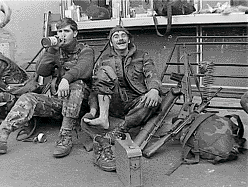 Before the war he was a Bosnian jeweller in Makarska but he left his wife and baby there to fight with the 156th Croatian Brigade. When the war moved to Bosnia he went to defend Sarajevo where his mother lives.
Today he is deeply disillusioned and wonders what to do. I asked him why Kiseljak is undamaged. He gave me a long, mysterious look:
"Would you like to buy a Volkswagon car for DM7,000?" he asked me. "You can buy one here. There is an assembly factory nearby, in Serbian territory. Serbs can buy these cars but they don't have much money. Croats can buy them. So can Bosnians.
 You see, this is a mafia war. This is not war between Muslims and Serbs or between Serbs and Croats. It's all about money, power, territory and control. This is Chicago but with big, big guns."
"Yesterday an old friend of mine from before the war, a Serb, took off his Serbian uniform and came into Kiseljak to see me. We had a drink together. He offered to get me a Volkswagon because he knows that my new Audi was stolen by the Posusje mafia a few months ago."
"I don't know how to explain all this to you, but here in Bosnia it's not an honourable war. There are no ideals. At every level, in every part of our lives, there is a hidden agenda. But people in Zagreb and in Europe will never understand what is happening. I would die if necessary to save the Bosnia I knew before this war. But I do not want to die for what is happening here now."
 What Zenan is saying is familiar. For mile after mile, day and night, an endless trail of thousands of battered lorries lurches along roads and mountain trails from the Dalmatian coast, across Hercegovina and into the heart of Bosnia. Some contain weapons and ammunition, others food and the necessities of any community. And they all pass through the numerous checkpoints on their 150 mile journey.
If the weaponry and ammunition is destined for the Bosnian army, the Hercegovinan Croats exact a 'commission' of up to 80 per cent of the consignment to let it through. If it's food and basic necessities, it too will be worth a portion of the load or a commission of hundreds or thousands of deutchmarks into the pockets of local militias and mafia-men.
"It's a very dirty war, you see," I am told again and again by men who are ashamed to find themselves themselves fighting for a cause they would never have chosen. "The [Serb] aim is to bombard Sarajevo to achieve just enough panic and shortages that the population will pay anything for the most basic necessities of life. Then you allow just enough supplies into the city to achieve the maximum price from those who still have gold, jewellery, hard currency or other valuables to sell."
The Croat mafia profits because everything has to cross their territory and check-points. The Serb mafias profit when the lorries finally have to cross their territory. Even then the game isn't over.
Waiting in Sarajevo are more mafia-men to see the distribution is as profitable as possible. And throughout this process the politicians and armies on all sides profit because they can bargain with the UN to let convoys through in return for prestige and deals."
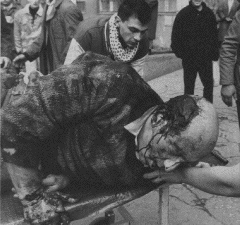 If the Serbs really wanted to destroy Sarajevo, I am assured, they could do it a few days. They could even poison the water supply. They could easily refuse to let in any food at all and starve the population to death. The trick is one of balance – supply and demand among a traumatised population in an atmosphere of terror.
As I prepare myself to drive out of HVO territory and through the Serbian front line to Sarajevo, I meet Sanja Pravdic, the 31 year-old wife of Vlado Pravdic, a member of the famous Bijelo Dugme band. She is pregnant and expecting her first baby in October. Every night she sits in the darkness of the hotel in Kiseljak while her husband is trapped in Sarajevo. She cannot go to him. He cannot escape to her. She can clearly hear the thud of gunfire and the sharper reports of mortars from the northern hills around Sarajevo. She wonders, of course, whether he will ever see their new baby.
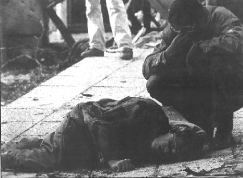 The distance between the last HVO check-point and the first Serbian check-point near Hadzici is a couple of hundred yards. They can wave to each other. As usual in this country I had put my precious English cigarettes into old Croatia packs and my whiskey was in my water-bottle. It was bad day for the guards.
And, of course, everything I had been told about the aid convoys and mafia control of Sarajevo's lifeline was clear to see – few people even attempting to pretend otherwise in this lawless landscape.
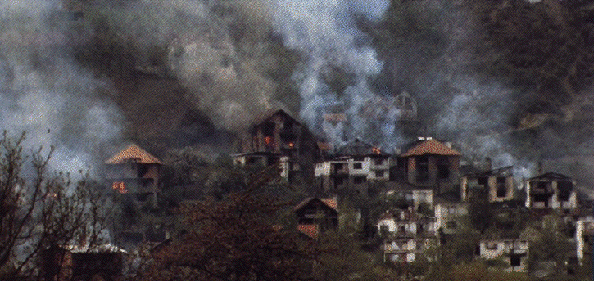

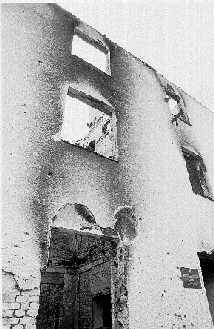
 It's hard to believe your eyes as you approach Sarajevo from Ilidza. Nearly every building is destroyed and burnt out.
Huge tangles of twisted steel mark factories destroyed by rocket fire and shells. Buses and lorries lie at crazy angles across the road. No-one can even go out to move them without the risk of being shot.
 We give each other route directions by references to 'the up-turned tank' or 'the crashed lorry under the collapsed bridge'.
A lorry lies on its side with tinned food on the road underneath it, but in this starving city no-one has yet risked collecting the harvest.
 From here, for about one kilometre, you drive as fast as the car will go up the wrong side of the dual carriageway, then stop as fast as you can at 'the two crashed lorries under the bridge', do the fastest U-turn you can and make a quick dash for safety behind the tower blocks opposite the UN headquarters.
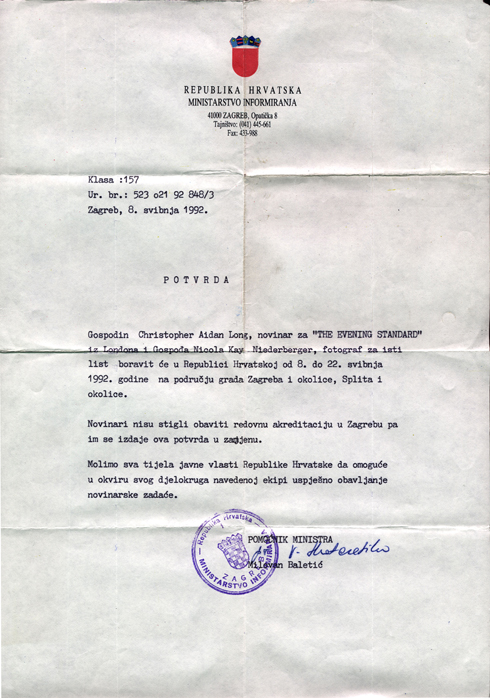
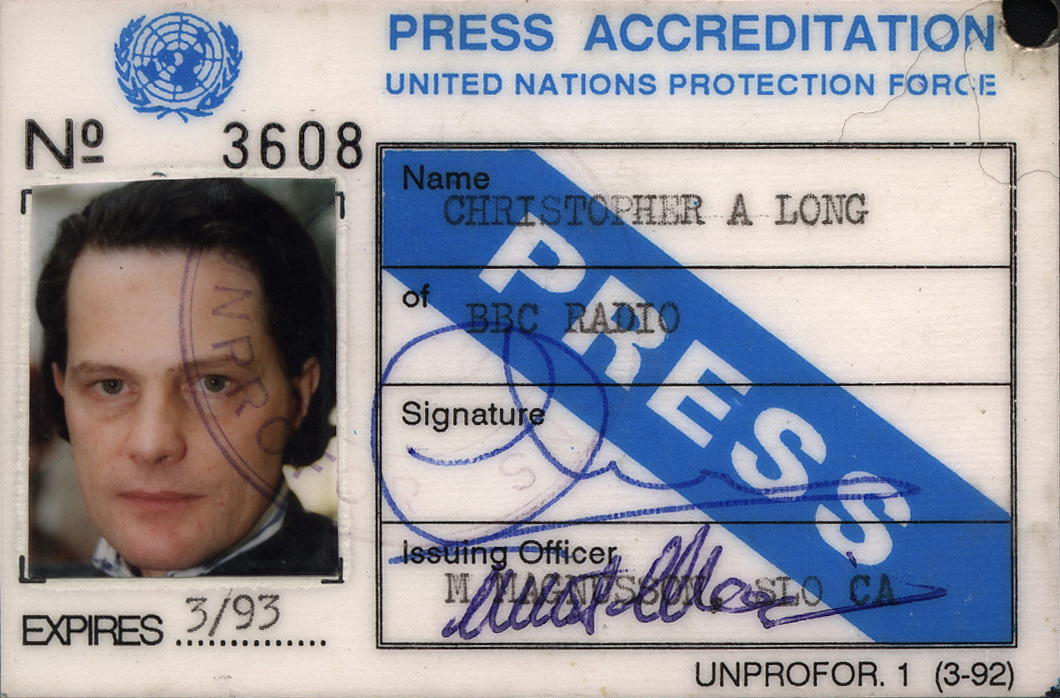
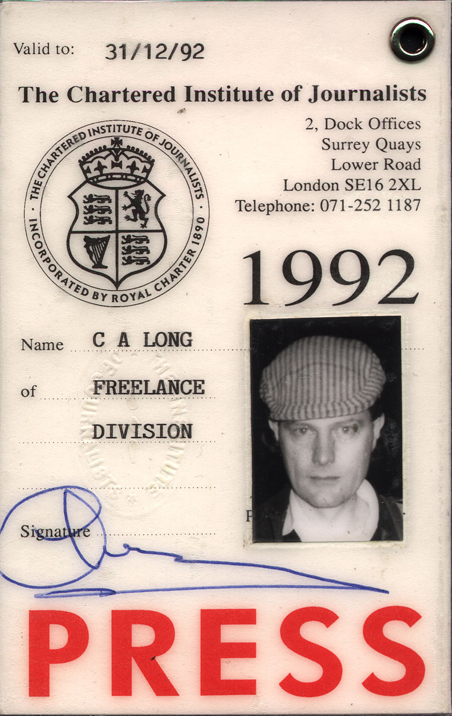
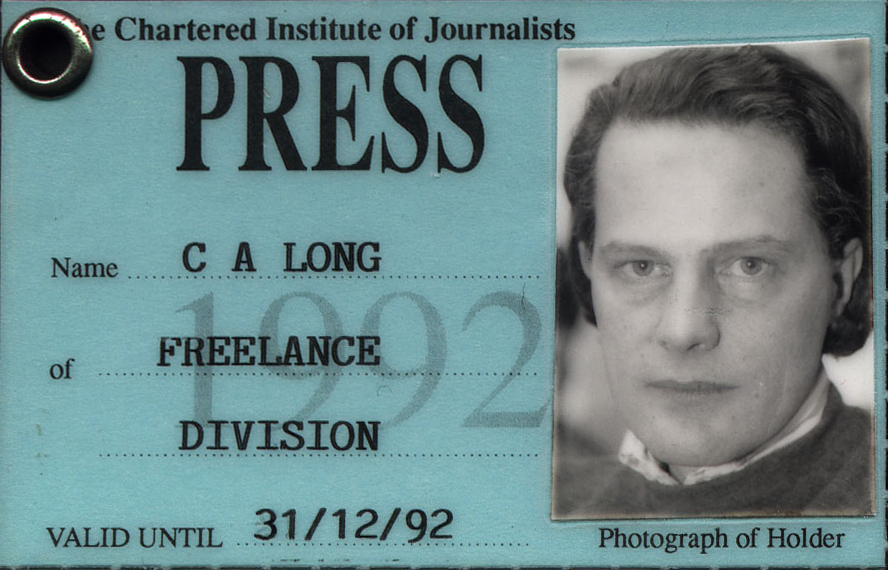
Above and right: A number of the press cards and accreditations which were supposedly needed in order to get across front-line borders. In the end, however, whether you got through a check point – or even survived the process – depended a great deal on how much alcohol or cannabis the paranoid and ill-disciplined militia guards had consumed that day...
 You avoid any north-south streets if you can. The guns on the southern hills fire straight up them. Many streets have steel barricades across them to give some protection to anyone travelling east or west, but you run across every intersection if the hills are visible.
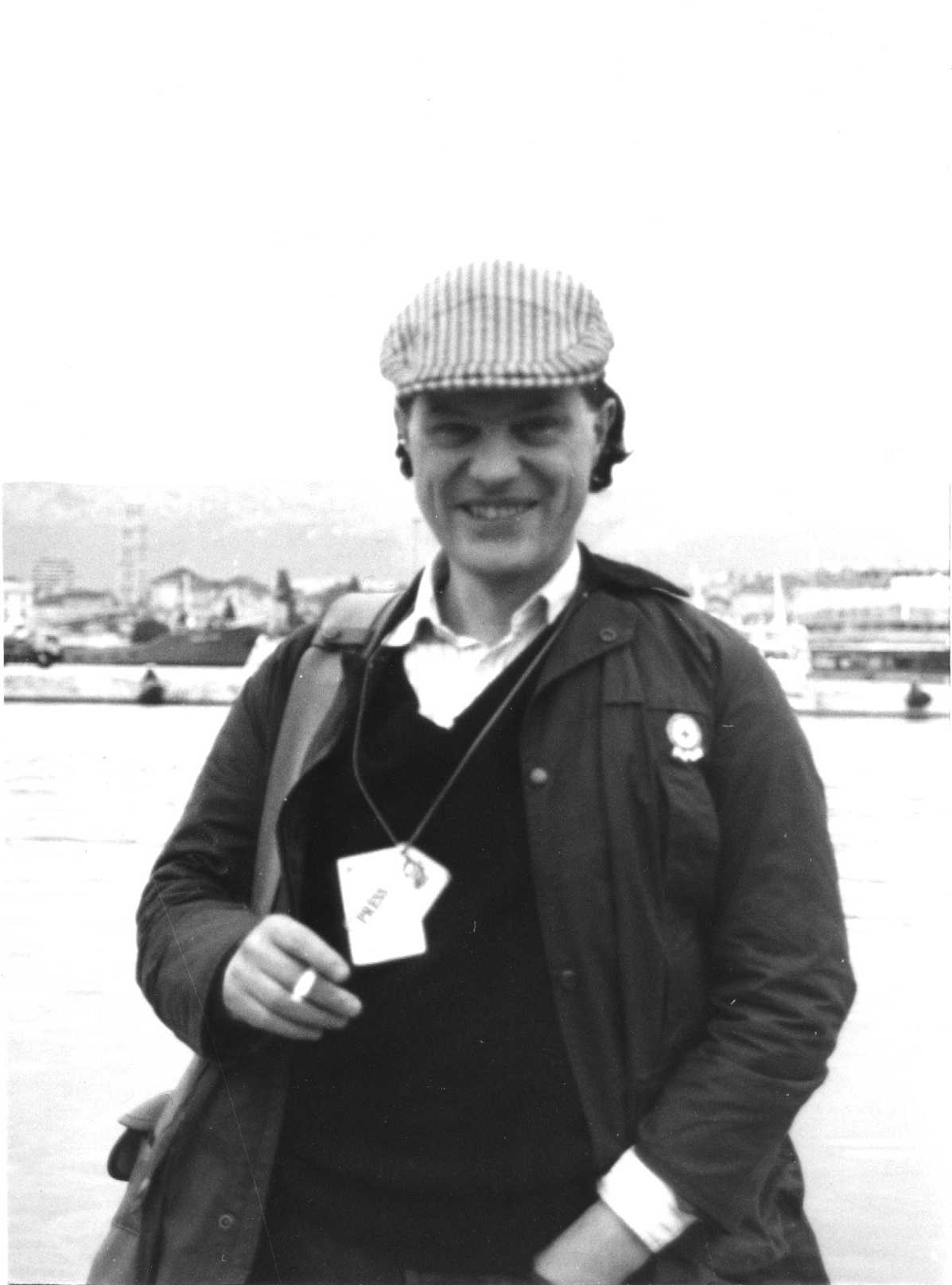
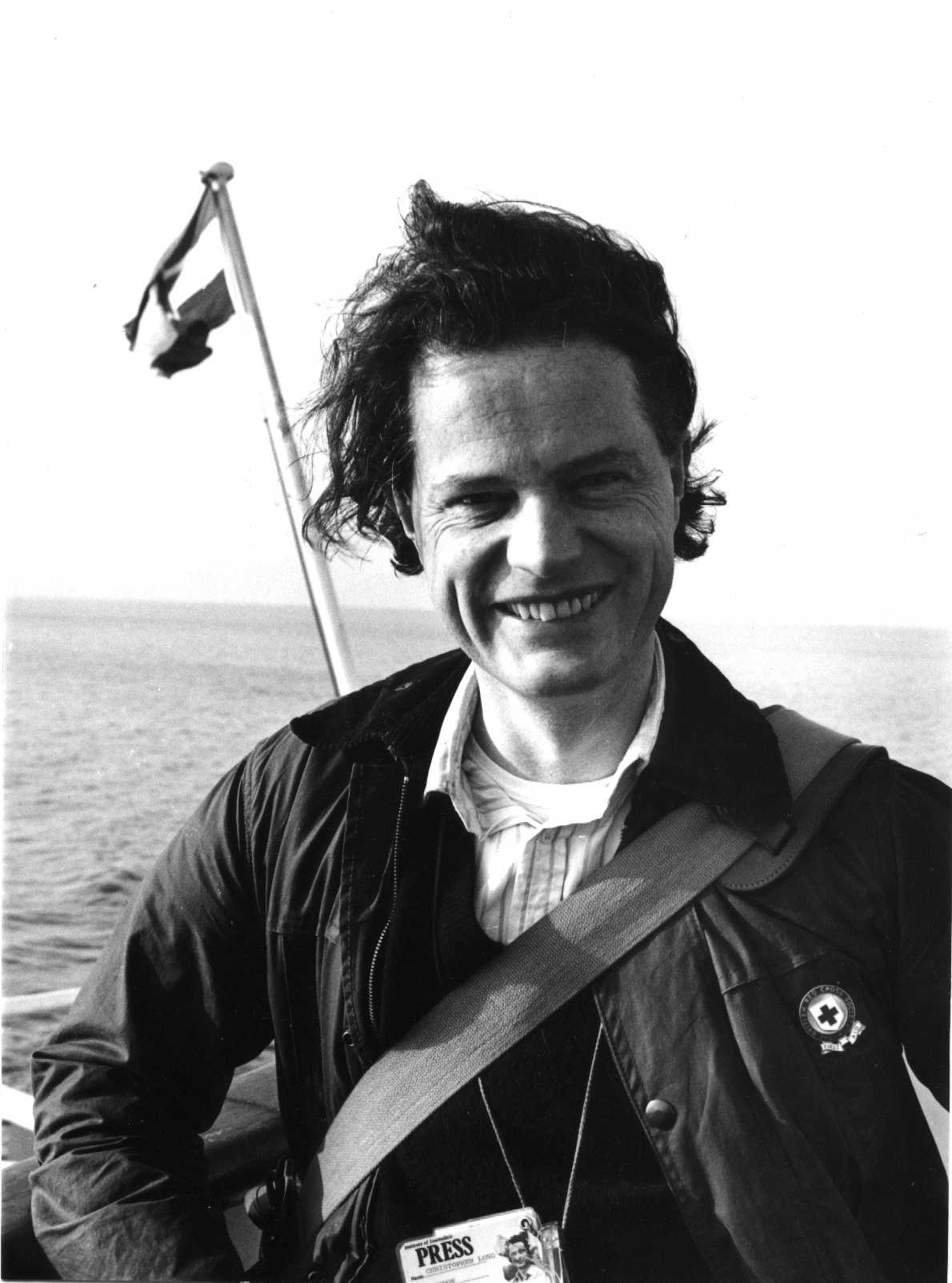
The author, in October 1991, aboard the MV Slavija as it steamed south towards another besieged city, Dubrovnik, during the Serbo-Croat war on the Dalmatian coast.
And yet children are playing on the grass. As one mother told me: "I have a choice. I can keep my children in the cellars, in the dark, for week after week, where they will be unhappy and still in danger when the building collapses. Or I can let them run free and be happy in the sun. If they have to die I would like them to die happily with their friends in the sun."
 In the town centre I meet an old friend, Goran Djapic, at the International Peace Centre in the Presidency Building.
Many journalists had a particular fear of the innumerable and often extremely dangerous checkpoints. Apart from the risk of being killed for one's car or hard currency, most also feared losing their professional kit without which they could not work.
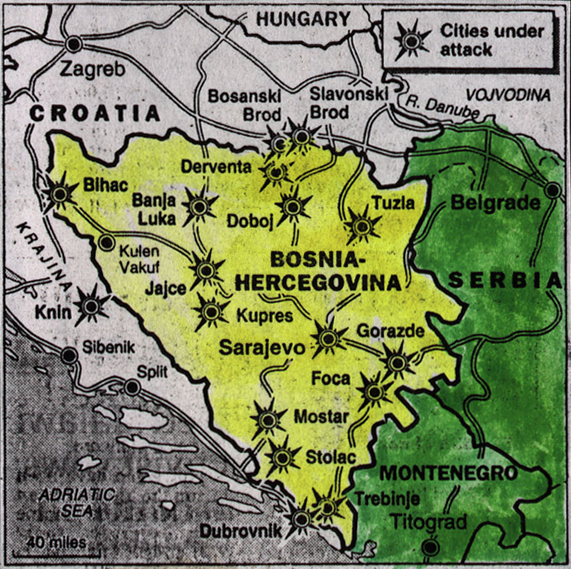
The author learnt that a shortage of military maps had led checkpoint guards to be ordered to be on the look-out for good quality road maps. He therefore took to getting out of his car, pretending to be lost (map in hand) to ask the guards for directions. In return he was 'happy' to leave the map with them in exchange for free passage. This became expensive... But even very small maps such as this cutting from a newspaper were sometimes useful when tucked into a small shirt pocket.
He and Ibrahim Spahic and hundreds of Serbs, Muslims, Croats and others are working to try and keep the old cosmopolitan spirit of tolerance alive in Sarajevo. They were embarrassed that they had no water or food to offer me. Instead we walked a long, long way round buildings and back-streets to reach a cafe almost exactly opposite the building where we had started.
"Run! Run fast!" Goran tells me sharply as we dive for the cafe entrance. Inside the atmosphere reminds me of stories of London during the Blitz in the 1940s. People are laughing and joking, doing their best to remain sane.
 "If you don't know what will happen tomorrow, you live for today," they say. "They can destroy the houses and kill the people, but not the spirit of Sarajevo."
In the summer of 1992, a few months after the Yugoslav wars spread into Bosnia-Hercegovina, great things were expected of the United Nations forces. Less than a year later few were in any doubt that the United Nations Protection Forces (UNPROFOR) were incapable of protecting themselves let alone the civilian populations of enclaves in Bosnia. Some claimed that UNPROFOR had become an essential but unwitting tool in the hands of the Croat and Serb militias which were then attempting to divide the territory between them and squeeze the Muslim population into oblivion.
Another friend, Lana, was very happy. Her father had managed to buy a book that morning which he had wanted for years.
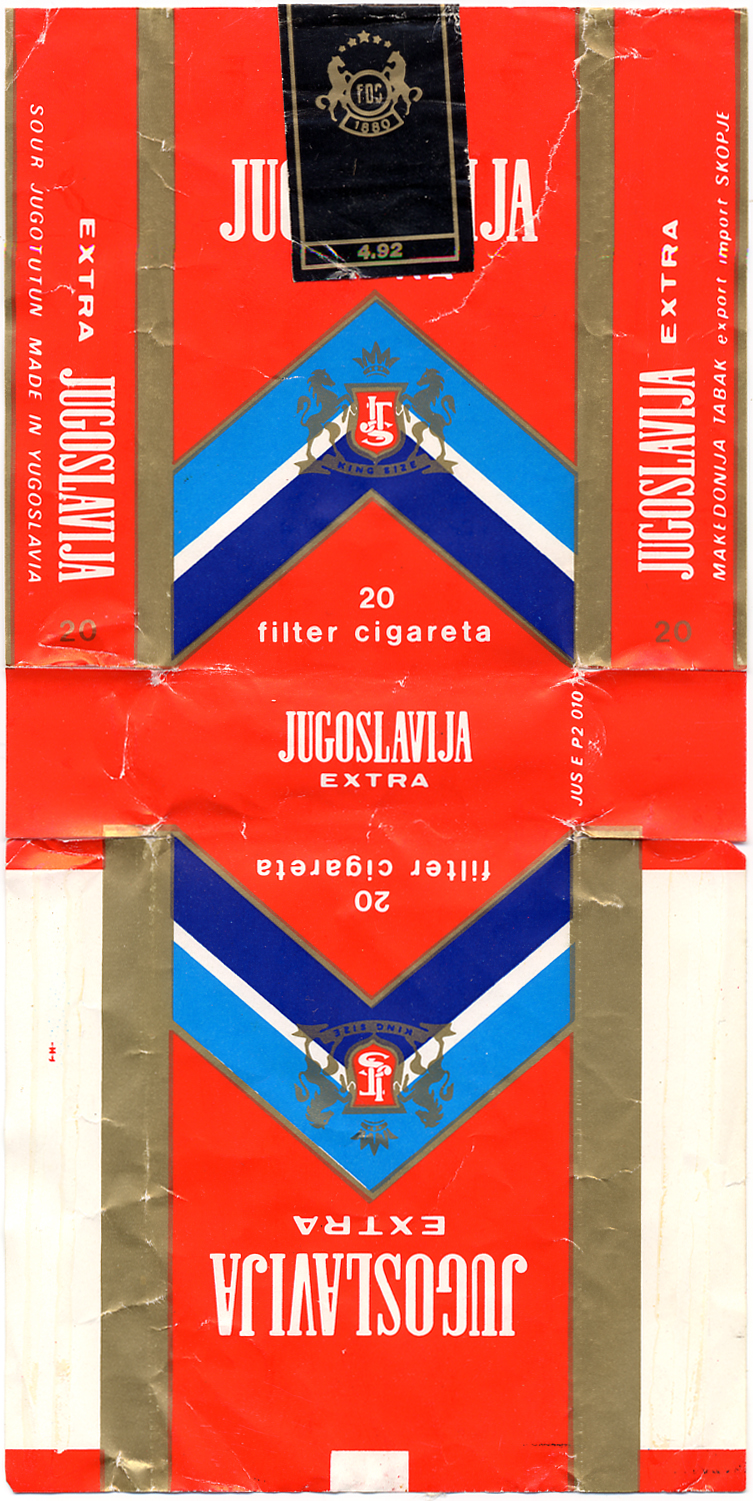
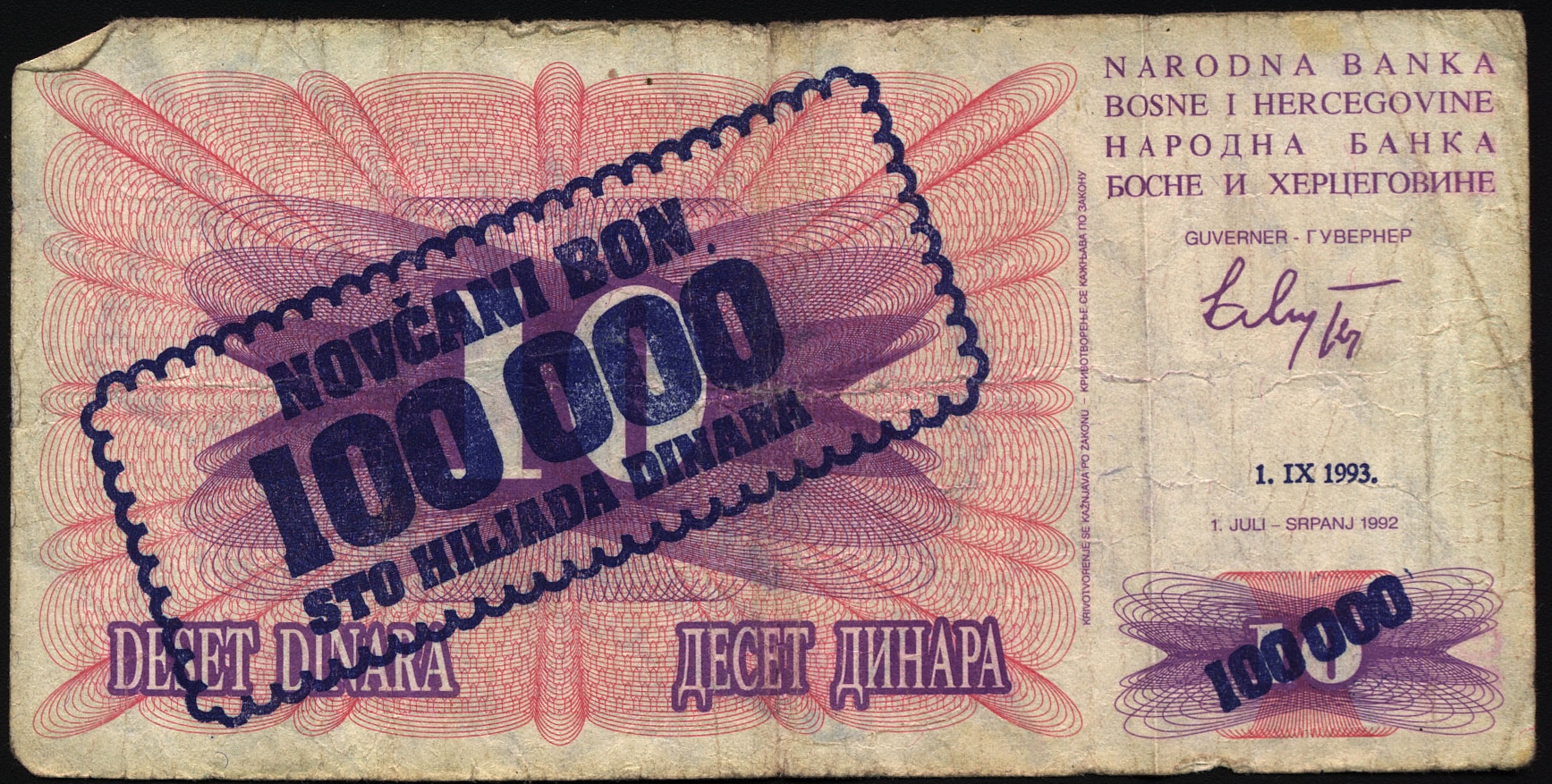 He paid seven cigarettes for it. But then 20 cigarettes cost DM30 – twenty times the price of cigarettes in Kiseljak, 20 kilometres away.
The Yugoslav bank note [above right] was originally worth 10 Dinars when it was printed and first distributed by the Bank of Bosnia & Hercegovina in July 1992. Just over a year later, in August 1993, it was over-stamped with a value of 100,000 Dinars. Catastrophic inflation of this sort helps to explain why Deutchmarks quickly became the preferred currency of war-torn ex-Yugoslavia.
Inflation meant that a packet of Jugoslavija cigarettes in Sarajevo in 1993 would have cost several million dinars – or, in Deutchmarks, the equivalent of about a week's pay for an average pre-war industrial worker.
I showed her new Croatian bank-notes which she had never seen before. "Yes, I think they were designed by a friend of mine. Can I have one?" And the 'reds', she noticed, are still red.
At high speed Goran drove me back to the UNPROFOR building. As he left in the darkness, in a borrowed car, I saw that his lights were off, but, too late, I noticed that the brake-lights were still connected. I literally crossed my fingers for him.
On 27th July 1992 the author was given a sound tape and asked to get it out of the besieged city and played in the outside world. It contained a song called Sarajevo's Crying, recorded by Bosnian musicians of the International Peace Centre wanting the world to know their beloved town was also dying. Within a week its was being played on BBC Radio, BBC World Service and various London radio stations.
Upstairs at UNPROFOR, a French aid worker was getting angry:
"God these people make me mad. No one helps anyone else in Yugoslavia. When the Serbs invaded Slovenia, the Croats and Bosnians did nothing to help. When Croatia was invaded the Slovenians did nothing to help. At least the poor Bosnians took in Croat refugees from Slavonia and fed them through the winter, but now Croatia won't take any more Muslims and we hear the Dalmatians want to clear the best hotels so they can have a tourist season!"
"Do you know," he said, "that in addition to the billions of dollars the people of Europe are paying for aid to the peoples of ex-Yugoslavia – not to mention the lives of foreign soldiers and aid workers and diplomats and journalists – the Croat airports are actually charging landing fees of about 1,000 dollars for every aircraft bringing in aid. Don't tell that to the British or they'll wonder just who they're being asked to help."
For three days I watched Sarajevo being shelled, mortared, machine-gunned and sniped at. On the fourth day I made the journey I had feared all along – to the airport. Lying flat on my back in the BBC Espace, I gazed in horror at the wreckage of Dobrinje. Could anybody still be alive there? A succession of UN convoys had escorted volunteer European and UNHCR aid workers into this hell-hole.
At the airport hundreds of foreign troops slave away in the heat to keep pace with the 150-200 tonnes of European aid coming in on up to 21 C160 air-freighters every day. All round the airport UN troops in hundreds of giant vehicles are on round-the-clock duty to keep open the one life-line to Sarajevo.
"I really don't understand why they hate us so much," a French navigator told me as we took off for Zagreb. "I'm tired of the attacks we get from both sides. It's not my war. I'd never heard of these places till a few months ago. Now they think we're pro-Serb or pro-Croat or that we should be fighting for one side or the other. I feel really, really sorry for the people of Sarajevo and all the refugees. But actually I think we'll all be very glad to go home. I'd like to continue doing aid flights to Ethiopia and Kurdistan. There, people were pleased to see us: actually said thank-you."
On board another plane, just ahead of us, was the little girl, one of many, who was being evacuated for treatment.
"Is she Muslim or Croat or what?" asked an American journalist.
"Don't know," a Swedish officer replied wearily. "Does it matter?"
ends
The author returned to Sarajevo four months later helping to guide the first British Overseas Development Agency (ODA) relief convoy from Zagreb to Sarajevo via Split, Metkovic, Mostar, Mount Igman, Sarajevo Airport and Dobrinje. This convoy of 12 lorries, carrying 150 tonnes of wheat flour for the central bakery in the Bosnian capital, was led by Alan Matthews, OBE. See: Sarajevo, November 1992.
The piece above was reproduced on the Tribunal Watch newsgroup by the philanthropist Nalini Lasiewicz on 10-02-98 and provoked the following response from Dubravko Kakarigi:
"The story which you placed on Tribunal Watch list recalled memories of my own escapades in the Split – Jablanica – Travnik – Fojnica – Kiseljak – Hrasnica – Sarajevo area in that time. Starting in early August 1992 and going on for the the next almost two years I have experienced those same things that the author writes about in his article. Except I never could enter Sarajevo through Ilidja but across Mount Igman and running across the airport runway under fire to Dobrinja. Those were the days...
I remember loading smaller trucks from the large ones and repackaging from large bags of food stuffs to smaller individual family packages and thinking how odd it was. Here I was thinking should I put a tangerine or an onion in the small space left in a package and suddenly realizing that someone will actually open that package and live off of it for some time never knowing or thinking that someone's hand actually placed every little piece in that box worrying about what was more important, a tangerine or an onion – very powerful, it still bring tears to my eyes.
love... ... dubravko" Dubravko Kakarigi
Grateful thanks to Rosie Goodman for some of the pictures on this page – and to anonymous others whom I would have liked to be able to credit personally.
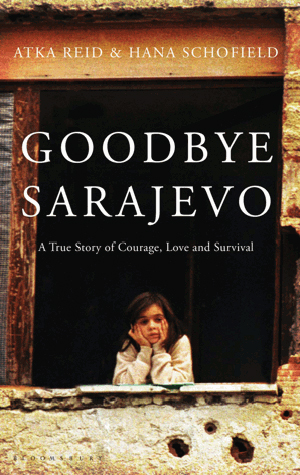 On 19 May 1992 the author met two young refugees, aged 12 and 15, who had escaped from Sarajevo and survived the lethal journey across the Bosnia-Hercegovina front lines to the relative safety of the Croatian coastal resort of Split.
There, among the flotsam and jetsam of war, he found they were in need of help.
Twenty years later the younger of the two, Hana Kafedzic, wrote a remarkable account of war through the eyes of its younger and most innocent victims: Goodbye Sarajevo. See the author's account of these days: Bosnia's Tide Of Human Misery (The Observer 25-05-1992).
Atka & Hana Kafedzic's story is strongly recommended reading!
On 31st July 1992 the author was asked by Croatian Radio to describe conditions in Bosnia-Hercegovina and Sarajevo.
On 4th December 1992 the author was asked by Croatian Radio to describe the deteriorating conditions in Bosnia-Hercegovina and Sarajevo.
A medley of a few of the author's radio reports for BBC Radio 4, BBC World Service, BBC Radio London, London Radio News, London Broadcasting Company (LBC), Capital Radio, etc.
In May 1992 the author was interviewing some of the thousands of refugees who were being driven out of Bosnia and Hercegovina by Bosnian Serb nationalists. Among these was Zenaida Alekic who was camping with her family in Split's sports stadium.
© (1992) Christopher Long. Copyright, Syndication & All Rights Reserved Worldwide.
The text and graphical content of this and linked documents are the copyright of their author and or creator and site designer, Christopher Long, unless otherwise stated. No publication, reproduction or exploitation of this material may be made in any form prior to clear written agreement of terms with the author or his agents.


